

It
might seem that the question has an easy answer; the answer would be
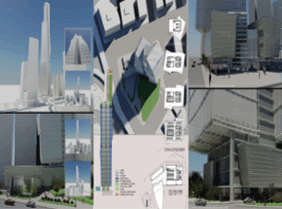
renderings, diagrams and animations as a result of using BIM. But, the more you
think about it the more you realize that there is a bigger answer. BIM touches
the entire investor presentation; the developer should take full advantage of
the “BIM Story” throughout their presentation to investors.
Why
do investors invest? And the answer is: To make money on their investment.
You
need to convince them that this is a good investment over all the other
investment options they have. The way to do this is to make them feel
comfortable with the:
1. Development and management
teams
2. The financial projections
3. The project design team
4. The construction team
5. Ongoing operations
6. The exit strategy or
incremental return on investment
The
areas that BIM will influence are all of the above. BIM is more important than
just communicating the design.
1. Today developers are just
starting to understand how important BIM is for the entirety of their project,
for the reasons discussed below. In ten years BIM will be as expected as the
financial projections. Investors will demand BIM. The sooner a developer weaves
BIM into their process and their story the better.
2. Financial
Projections:
The use of BIM and IPD (Integrated Project Delivery) is resulting in project
costs coming in at ten to twenty percent below traditional construction costs
of non BIM/IPD projects. This means that if two similar investments are
available the BIM project will result in a better return on the investment.
Developers are hearing of these results and developers will demand BIM
projects. Developers that use BIM can give a story today that can separate
themselves from other developers. In ten years the integration of modeling,
costing, and financing will allow real time “what ifs” resulting in better
projects for the developers to create and sell.
3. The
Project Design Team:
This is the logical category for the use of BIM. The use of BIM to design the
project will result in better designs, visualization and contract documents.
· Design — BIM allows the designer to
better see the results of their ideas and to then refine their designs. There
is no doubt that BIM will help create better aesthetics, more efficient layouts
and better buildings.
· Visualization — Many people cannot
visualize a building from plans and elevations. The byproduct of the use of BIM
is the ease with which renderings and animations may be created. Investors need
to understand what they are investing in, the renderings and animations are
critical to the investors understanding the building. Projects that clearly
show the end results are much more likely to attract investors.
· Contract
Documents —
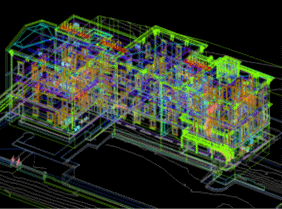
Even now when most architects and engineers are still modeling in BIM for the
creation of paper drawings the drawings are more accurate and have less chance
of errors and omissions. Consultants work is more accurately integrated. When
BIM contract documents move to the next stage of BIM (modeled with construction
level detail included and correctly created objects) the value further
increases with the immediate result of lower construction costs, links to
analysis and downstream use for operations and facilities management.
4. The
Construction Team:
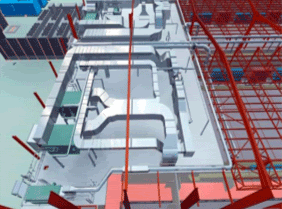
I have heard that Autodesk is licensing more Revit programs to contractors than
architects. This is very logical to me for the 3D model is valuable for
planning construction sequences, cost estimations and bidding, conflict
resolution and visualization. I have seen contractor presentations where the
contractor models the project in great detail in several versions. The final
costs for the same square footage vary more than 30%. If the developer is using
contractors that use BIM, and even better IPD they can promote to the investors
that they are maximizing the investment and eliminating the traditional waste
of money found in design and construction.
5. Ongoing
Operations:
Every dollar spent operating and maintaining the completed project is money
taken out of profit. Better designed and constructed projects require less
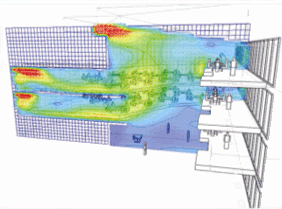
money for repairs and maintenance and less money spent on energy. BIM can be
used to populate analysis programs that help the designers refine the design of
the building for minimal energy use. The near future will find more and more
information associated with the objects (products) that are selected for use in
the projects. More and better information will result in more informed
selections and the use of products and materials that will last longer and
perform better.
6. Exit
Strategy or Incremental Return on Investment: Poorly designed,
constructed and operated projects are a disaster and they will end up as a very
bad investment. I have investigated scores of projects that devoured money with
poor designs, bad HVAC systems, leaks, and failed plumbing. Investors look for
professional teams that they believe in. A team that is knowledgeable of BIM,
and uses BIM has a much higher likelihood of success. This success will result
in a project that is more valuable throughout its life and therefore more
valuable when it is sold.
Conclusion
BIM will change everything for everyone involved in building projects. The sooner developers understand all the consequences of BIM the sooner they will take advantage of the positive changes BIM brings.
BIM will change everything for everyone involved in building projects. The sooner developers understand all the consequences of BIM the sooner they will take advantage of the positive changes BIM brings.













0 Response to "How can BIM, Building Information Modeling, effectively communicate the design of a new multi-sport facility in order to engage investors in financial participation?"
Post a Comment