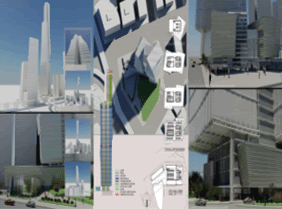

DESIGN SUPPORT SERVICES

  • Schematic Design to Construction Documentation
  • Code Compliance Analysis
  • Delivery Systems Standardization
  • Shop Drawings & Built Drawings
  • Paper to CAD Conversion
  • 3D Visualization
  • Shop drawings & As-Built drawings

Design Support Services

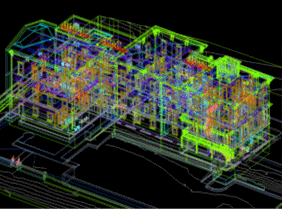
BUILDING INFORMATION MODELING

  • Creating BIM model from sketches, CAD drawings etc.
  • Generation of study model for volumetric design analysis
    and conflict detection
  • Creation of virtual product library of building products with
    manufacturer specs
  • Extraction of quantities, schedules, cost estimation and area
    charts from the model
  • Documentation for all design stages
  • Renderings and Animations
  • Integrated Project Delivery using BIM - Design, Construction,
    Facility management

building information modeling

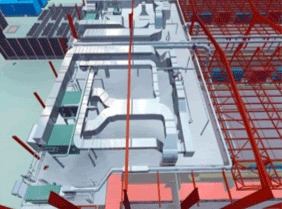
VIRTUAL DESIGN & CONSTRUCTION

  • Virtual building modeling from 2D drawings
  • Model enrichment of existing models with construction
    specific information
  • Cost Modeling & Estimation
  • Analysis models for trade coordination, conflict resolution
    and sequencing
  • Option Study – Analyze ‘what-if’ scenarios
  • As-built Modeling & Documentation

Virtual Design Construction

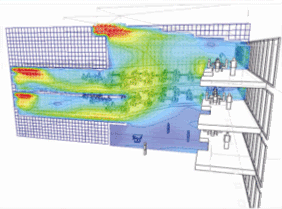
BIM + GREEN

  • Building Performance Evaluation
  • LEED Facilitation
  • Creating Building Simulation Models using Autodesk Green Building
    Studio, ECOTECT and IES

Bim + Green

DESIGN MANAGEMENT SERVICES

  • Design Coordination Services
  • Design Localization Services
  • Design Documentation Services
  • BIM Management Services

Design Management Services

(Mis)understanding BIM

Posted by Carol Parker On 7:10 AM 1 comments

CAD means Computer Aided Design which is so vague as to be virtually indefinable, yet we all inherently know what CAD means. The context we use it in helps to define it. BIM, on the other hand, has very little context at this point and when it does it is often confused and unclear.

What is BIM and why is the industry so confused? To answer that question it is probably easier to first define what BIM is not.

BIM is not 3D

3D alone does not give you a Building Information Modeling solution. Consider a SketchUp model - a representation of a building, project or component in 3D. There is no added intelligence to give you any “data” about the project. To understand what each element represents it is necessary for the person using the model to interpret the geometry. As soon as you add the model into Google Earth it suddenly inherits additional project information: where it exists spatially. The model has now become “BIM” (albeit simply).

Conversely, BIM does not have to be in 3D. It is quite possible to have a BIM model in 2D alone. A simple example is the use of a line and arc to represent a door. As with the SketchUp example above the lines and arcs have to be interpreted as a door. Once those elements have been put on a doors layer (e.g. A-G322-G-Door in the AEC CAD Standard) they now have added intelligence; building information that tells someone using the file what those elements represent. Taking that further the elements could be part of a block or cell with attributes (tags) added to them. This is a simple 2D Building Information Modeling concept.

BIM is not Revit

Autodesk have got a powerful marketing machine… For years now I’ve heard people tell me how they would do something in “CAD”. “What software?” I always reply. “CAD, you know, Autodesk CAD”. The same thing appears to be happening with BIM. The terms BIM and Revit are becoming interchangeable. Be aware that Revit, whilst being a BIM solution, is not BIM. Even if you use Revit you can use it without being BIM at all.

BIM is not a single database or “single building model”

This is one of the main confusions with regard to adopting BIM. A lot of people believe BIM has to be a single database from which every party extracts their information in the format they require. Even some software manufacturers describe BIM as having to use a single database in order for it to be BIM:

“Building information modeling solutions have three characteristics:
  1. They create and operate on digital databases for collaboration.
  2. They manage change throughout those databases so that a change to any part of the database is coordinated in all other parts.
  3. They capture and preserve information for reuse by additional industry-specific applications.”
Or
“The idea behind a building information model is that of a single repository. Every item is described only once. Both graphical documents/drawings and non-graphical     documents - specifications, schedules, and other data are included. Changes are made to each item in only one place.”

It is better to think of BIM as a series of models. You may have an architectural model (in 3D), you may have a structural model (in 2D). Each of these models may be made up from a series of DGN or DWG references to allow individual access to a package of work. BIM doesn’t have to be any different to existing CAD in terms of processes and data management.

BIM is not Project Lifecycle Management

For some reason as soon as BIM is mentioned the assumption is made that “it’s only BIM if everyone in the team, from conception to facilities management is involved”. While well-managed data will improve the flow of information through the design, construction and post-construction phases, this is not a definitive requirement of BIM. Far from it; I would always recommend anyone starting down the BIM road to consider only their internal benefits in the first instance. Understand where the production “bottlenecks” occur and see if there is a BIM solution that can address them. It may be drawing or schedule production, or the dynamic linking of the two together, or any number of design processes that can be improved internally. Only once you have developed a sound working method for your project can you start to consider the rest of the office. Only once you have developed sound working procedures for your office can you start to consider the implications of including other collaborators into the equation. Take it one simple step at a time; there are an infinite number of shades of grey between black and white.

BIM is not Building Information Modeling

I find it helps to think of BIM as Building Information Management rather than modeling. Just like CAD isn’t only vector-based lines, arcs and circles, but is instead a mix of vector elements, raster images, printer configurations, plot styles or pen tables, Word files, spreadsheets, and a whole host of other hybrid formats and data, so is BIM. It’s not a single piece of software, it’s not a database, it’s not a 3D model, and it’s not a particular phase in a project - although it can be all of these things.

So what is BIM?

In simple terms BIM is the management of project information, both the construction of that data and the iterative process of exchanging it. BIM is the added intelligence to project data that allows anyone to interpret that data correctly, removing the risk of assumptions. BIM is the process by which the right information is made available to the right person at the right time.
| | edit post


Barwa Commercial Avenue is an 8-kilometer development of road as well as a mixed development of buildings, set to transform the project area into commercial complexes, showrooms and homes as part of this mixed development project Barwa will offer about 600 retail spaces and about 850 residential units and offices for occupation. The residential units that are part of the project will have 3 different types of configurations ranging from 3 to 2 to 1 bedroom. The construction is being carried out using 5 ultra modern designs. The public areas will have food courts, groceries, pharmacies and all other manner of amenities that will serve those who will live and work in this space.


Commercial Avenue is also to feature impressive shopping malls, housing top retail names and brands. Specialist shops are to be set up in the area to cater to the needs of the elite occupants. Fine dining restaurants will also be part of the Commercial Avenue project, making it a likely location where clients will have an opportunity to mix business with pleasure. The area will be landscaped and laid out to meet the highest international standards. The space once developed will be the location to host many an exhibition related to the commercial enterprises housed nearby; all these features marks Barwa Commercial Avenue as a place of commerce and culture.


The investment is in response to the economy that is averaging a 10% growth per annum and ranks as one the fastest growing in the world. Barwa Commercial Avenue is intended to not just attract but also convince young national entrepreneurs of the vast opportunities abounding and the availability of space to set up a business. The arrival of international investors in Qatar only means they will find investments such Barwa Commercial Avenue appealing and a major determinant in their decision to invest in Qatar. The project will be completed in 2010.


| | edit post

While the design of environmentally friendly green buildings has become an important influence for architects, it is often difficult to demonstrate their advantages to building owners. Analysis of the design concept with traditional two-dimensional (2D) CAD solutions requires a great deal of human intervention and interpretation, which renders the process inaccurate, costly, and time consuming. Without the ability to easily demonstrate the value of the design intent, important sustainable ideas are often not realized.

Architects who are implementing BIM technology are also finding, supported by appropriate technology, that it has the potential to reduce the cost of sustainable design. With BIM radically transforming the way designs are created, communicated, and constructed, it greatly increases the ability to manipulate the data in an unprecedented, interoperable format that is maintained throughout the lifecycle of the building while allowing for some of the information required for green design, analysis, and LEED® certification to be routinely available as a byproduct of the standard design process.

The current BIM platforms in the industry, are based on the development of a three dimension virtual building model with a wealth of underlying information built into the project. The immediate advantage for architects is to build this model utilizing the appropriate sustainable design options for the building in the context of its surrounding environment.

With these green design options fully realized, we can take a more complex look at the design. For example, we can use the BIM model to understand the sun’s impact on the building or pace. With the full model built, daylighting views and solar studies can provide an immediate insight into the functionality and performance of the design. We must also realize this insight is generated with minimal effort through still and animated images that allow us to provide the building owner a visual representation of the value created by these green design decisions.

With this information in place as part of the typical BIM design process, we can continue to use that information in an interoperable format with other standard software and analysis packages. Previously, it was cost prohibitive for us to recreate the information from our 2D construction documentation into a useful analysis format, which is no longer the case. Through the ideas of interoperability and neutral file format exchanges, we can export the relevant data from our BIM model and use it in the appropriate analysis packages.

With multiple design options to be evaluated and analyzed for sustainable design, the interoperability of BIM allows us to upload an exported gbXML file to the Green Building Studio website. Here we can run a whole building energy analysis that will quickly generate an energy statistic report back to the design team. Then we can compare how the multiple design options will perform throughout the building’s lifecycle, giving us the ability to understand its estimated energy consumption and related cost summary. Along with this analysis we can then outline a return on investment to the owner; thus validating the green design options we are trying to achieve.

Another underlying philosophy of the BIM workflow is the availability of information in the model. Being able to schedule and calculate quantities of objects, materials, volume, and square footages throughout a building, can supply team members with the critical information they require at any phase of the project. Schedules and quantities can be generated for construction documents or cost estimating purposes regardless of the project type. When designing with a sustainable focus in mind, that same information can be extremely helpful when compiling building information to achieve LEED Certification. According to Autodesk, “For LEED certification, up to 20 points can be facilitated through state-of-the-art building information modeling using Autodesk Revit Building.”

With the power to create relationships among different design features, BIM transforms information into a meaningful and functional representation of all building elements. BIM introduces an unprecedented degree of design collaboration that will benefit not only the environment, but also the architects, the building owner, and the design profession itself.

| | edit post

About Me

My photo
I'm a Business Development Manager with ARCHiGENESIS, Inc. focused on understanding the specific requirements of clients and offering them solutions tailored to achieve the desired results.