

While the design of environmentally
friendly green buildings has become an important influence for architects, it
is often difficult to demonstrate their advantages to building owners. Analysis
of the design concept with traditional two-dimensional (2D) CAD solutions
requires a great deal of human intervention and interpretation, which renders
the process inaccurate, costly, and time consuming. Without the ability to
easily demonstrate the value of the design intent, important sustainable ideas
are often not realized.
Architects who are implementing BIM
technology are also finding, supported by appropriate technology, that it has
the potential to reduce the cost of sustainable design. With BIM radically
transforming the way designs are created, communicated, and constructed, it
greatly increases the ability to manipulate the data in an unprecedented,
interoperable format that is maintained throughout the lifecycle of the
building while allowing for some of the information required for green design,
analysis, and LEED® certification to be routinely available as a byproduct of
the standard design process.
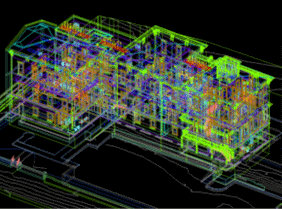
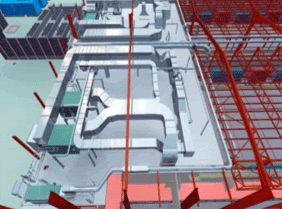
The current BIM platforms in the
industry, are based on the development of a three dimension virtual building
model with a wealth of underlying information built into the project. The
immediate advantage for architects is to build this model utilizing the
appropriate sustainable design options for the building in the context of its
surrounding environment.
With these green design options
fully realized, we can take a more complex look at the design. For example, we
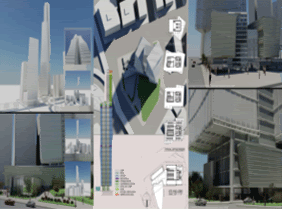
can use the BIM model to understand the sun’s impact on the building or pace.
With the full model built, daylighting views and solar studies can provide an
immediate insight into the functionality and performance of the design. We must
also realize this insight is generated with minimal effort through still
and animated images that allow us to provide the building owner a visual
representation of the value created by these green design decisions.
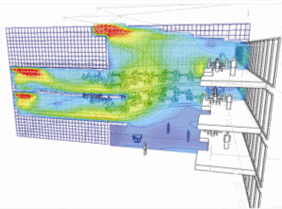
With this information in place as
part of the typical BIM design process, we can continue to use that information
in an interoperable format with other standard software and analysis packages. Previously, it was cost prohibitive for us to recreate the information from our
2D construction documentation into a useful analysis format, which is no longer
the case. Through the ideas of interoperability and neutral file format
exchanges, we can export the relevant data from our BIM model and use it in the
appropriate analysis packages.
With multiple design options to be
evaluated and analyzed for sustainable design, the interoperability of BIM
allows us to upload an exported gbXML file to the Green Building Studio
website. Here we can run a whole building energy analysis that will quickly
generate an energy statistic report back to the design team. Then we can
compare how the multiple design options will perform throughout the building’s
lifecycle, giving us the ability to understand its estimated energy consumption
and related cost summary. Along with this analysis we can then outline a return
on investment to the owner; thus validating the green design options we are
trying to achieve.
Another underlying philosophy of the
BIM workflow is the availability of information in the model. Being able to
schedule and calculate quantities of objects, materials, volume, and square
footages throughout a building, can supply team members with the critical
information they require at any phase of the project. Schedules and quantities
can be generated for construction documents or cost estimating
purposes regardless of the project type. When designing with a sustainable
focus in mind, that same information can be extremely helpful when compiling
building information to achieve LEED Certification. According to Autodesk, “For
LEED certification, up to 20 points can be facilitated through state-of-the-art
building information modeling using Autodesk Revit Building.”
With the power to create
relationships among different design features, BIM transforms information into
a meaningful and functional representation of all building elements. BIM
introduces an unprecedented degree of design collaboration that will benefit
not only the environment, but also the architects, the building owner, and the
design profession itself.













0 Response to "Designing Green with Building Information Modeling (BIM)"
Post a Comment